My Voice Will Go With You: The Teaching Tales of Milton H. Erickson, M.D. by Milton H. Erickson & Sidney Rosen
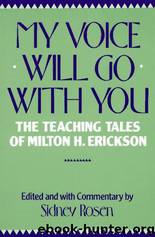
Author:Milton H. Erickson & Sidney Rosen
Language: eng
Format: mobi
Tags: Psychotherapy, Psychology, Hypnotism, General
ISBN: 9780393301359
Publisher: Norton
Published: 1991-08-15T00:00:00+00:00
6. Reframing
There are many examples of the refraining process in the literature of psychotherapy. One of the most memorable is Victor Frank]'s account of being in a concentration camp in his book From Death-Camp to Existentialism. While most of his fellow inmates lost hope and subsequently died, Frank! occupied his mind thinking about the lectures he would give after his release —lectures that would draw on his experiences in the camp. Thus, he reframed the potentially deadening and hopeless situation. He transformed it in his mind to a source of rich experiences that he could use to help others overcome apparently hopeless situations —physical or mental. Of course, there are skeptics who would say that this type of thinking had no effect on his subsequent survival; or that hopelessness did not necessarily condemn the inmates to death. Be that as it may, that type of thinking certainly kept his spirits and his mind alive at that time. And, it may also have kept his body alive. Again, we note that Frankl's refraining was syntonic with his general orientation to life. He did value teaching and he had experiences with lecturing, so that it was natural for him to use this experience as source material for lectures in the future.
Watzlawick, Weakhnd, and Fisch, in Change, say: "To re-frame means to change the conceptual and/or emotional setting or viewpoint in relation to which a situation is experienced and to place it in another frame which fits the 'facts' of the same concrete situation equally well, or even better, and thereby changes its entire meaning."
These authors quote the philosopher Epictetus as saying, "It is not the things themselves which trouble me, but the opinions that we have about these things." They point out that "our experience of the world is based on the categorization of the objects of our perception into classes," arid that "once an object is conceptualized as the member of a given class, it is extremely difficult to see it also as belonging to another class." With refraining, once we see "alternative class memberships," it is difficult to go back to our previously limited view of "reality."
The following talks provide examples of ways in which Erickson used reframing.
RAISING THEIR BIGNESS
My son, Robert, had put a second story on his home. The night before, he and his wife had moved upstairs. Little five-year-old Douglas and two-year-old Becky were terribly afraid because they had to be left downstairs. Robert came to me. So I advised Robert, "Douglas's bed is lower than the parental bed." Robert was to stress how big a boy he was and relate his bigness to the bigness of the parental bed that was left downstairs. And Becky was to relate her bigness to the bigness of Douglas's bed.
And then I told Robert to make sure the children knew how they could use the intercom from downstairs to upstairs. And they slept beautifully, though Douglas had been very worried. He even had asked if he could sleep upstairs the first few nights.
Download
This site does not store any files on its server. We only index and link to content provided by other sites. Please contact the content providers to delete copyright contents if any and email us, we'll remove relevant links or contents immediately.
Talking to Strangers by Malcolm Gladwell(13376)
The Compound Effect by Darren Hardy(8978)
Tools of Titans by Timothy Ferriss(8403)
Wonder by R. J. Palacio(8118)
The Lover by Duras Marguerite(7907)
A Court of Wings and Ruin by Sarah J. Maas(7858)
The Circle by Dave Eggers(7121)
Deep Work by Cal Newport(7090)
Kaplan MCAT General Chemistry Review by Kaplan(6939)
To All the Boys I've Loved Before by Jenny Han(5858)
Wiseguy by Nicholas Pileggi(5795)
The Body: A Guide for Occupants by Bill Bryson(5103)
Eat That Frog! by Brian Tracy(4546)
1,001 ASVAB Practice Questions For Dummies by Powers Rod(4511)
Cracking the GRE Premium Edition with 6 Practice Tests, 2015 (Graduate School Test Preparation) by Princeton Review(4298)
Pre-Suasion: A Revolutionary Way to Influence and Persuade by Robert Cialdini(4236)
Barron's AP Biology by Goldberg M.S. Deborah T(4155)
ACT Math For Dummies by Zegarelli Mark(4054)
Alive: The Story of the Andes Survivors by Piers Paul Read(4037)
